
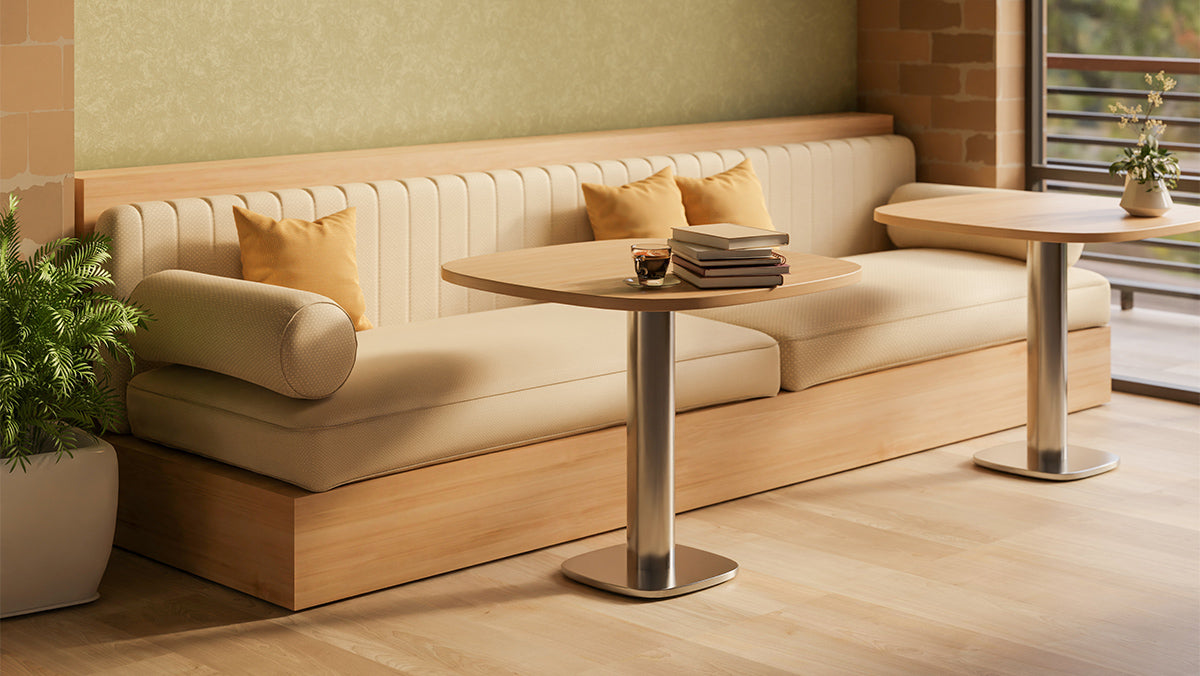
How Much Space Do You Really Need for a Kitchen Booth?
Kitchen booth seating looks effortless in magazines. A cosy corner. A soft upholstered bench. A perfectly sized table. Clean lines. No clutter.
But behind every beautiful kitchen booth is one crucial factor:
Correct spacing.
Too shallow and it feels cramped.
Too deep and it eats into your room.
Too tight on walkways and your kitchen becomes frustrating to use.
If you're considering a kitchen booth for your home, this guide will walk you through exactly how much space you really need — covering seat depth, table size, clearance zones, storage allowances and layout planning.
By the end, you’ll know whether a booth seating layout will work comfortably in your kitchen — and how to get the measurements right.
Why Spacing Matters More Than Style
Home booth seating is different from restaurant booth seating.
In a restaurant, layouts are optimised for turnover and maximum seating density. At home, comfort and flow matter more.
Your kitchen booth will likely be used for:
- Family meals
- Homework and laptop work
- Socialising with guests
- Everyday breakfast and quick meals
- Possibly even remote working
That means circulation space and ergonomic comfort are essential.
Before choosing fabrics or styles, you need to get the footprint right.
If you’re still deciding between layouts, our blog on 10 Beautiful Kitchen Booth Ideas for Modern Homes can help clarify which configuration suits your room best.

The Core Dimensions of Kitchen Booth Seating
Let’s break this down into the essential measurements.
1. Seat Depth: How Deep Should a Kitchen Booth Be?
For comfortable home use, ideal seat depth is:
450–500mm usable seating depth
This is the depth from the front edge of the seat to the back cushion (not including the backrest thickness itself).
Too shallow (under 420mm), and adults feel perched.
Too deep (over 520mm), and it becomes difficult to sit upright at a table.
Total Unit Depth
Including:
- Seat base
- Backrest thickness
- Structural framework
Most kitchen booth seating units measure:
550–650mm total depth
This is the space the unit takes from the wall into the room.
If your kitchen is narrow, this dimension is critical.
2. Seat Height: What’s Comfortable for Dining?
Standard dining chair seat height in the UK is:
450–480mm
Kitchen booth seating should fall within that range to align properly with standard dining tables (usually 720–760mm high).
If seat height is too low:
- Knees sit too high
- Table feels awkward
If seat height is too high:
- Feet may not sit flat
- Table clearance feels tight
A well-designed booth should match standard dining ergonomics.
3. Table Overhang: Don’t Forget This
A common mistake when planning a kitchen booth is forgetting table overhang.
Ideally, your dining table should overhang the booth seat by:
20–30mm minimum
This ensures:
- Comfortable knee clearance
- No rubbing against seat edges
- Easier movement in and out
If you’re pairing a pedestal table with your booth, overhang becomes even more important to avoid knee collisions.
Walkway Clearance: The Most Overlooked Measurement
This is where most people go wrong.
Once your booth and table are installed, you need space to move around them.
For comfortable residential use:
Minimum clearance behind seating or chairs: 600mm
Comfortable clearance: 700–800mm
If your booth is against a wall:
You only need clearance on the open sides of the table.
If your booth faces another seating run or chairs:
You need clearance on both sides.
Example Scenario
Let’s say:
- Booth depth = 600mm
- Table width = 800mm
- Chair depth opposite = 500mm
- Walkway clearance = 700mm
Total depth required:
600 + 800 + 500 + 700 = 2,600mm
That’s over 2.6 metres.
This is why L-shaped kitchen booth seating often works better in smaller rooms — because it eliminates seating on two sides and reduces clearance requirements.
You can explore layout options across our full booth seating collection here, including both straight and L-shaped designs.

How Much Space Do You Need for an L-Shaped Kitchen Booth?
An L-shaped booth is usually placed into a corner.
For a comfortable 4-person L-shaped booth setup, you typically need:
- 1,500–1,800mm length on the long side
- 1,200–1,500mm on the return side
- 550–650mm booth depth
- 700mm clearance on the open sides
Because two sides sit against walls, L-shaped seating is often more space-efficient.
It works especially well in:
- Small kitchen extensions
- Open-plan corner zones
- Bay windows
- Compact family kitchens
How Much Space Do You Need for Straight Booth Seating?
Straight booth seating runs along a single wall.
A typical 3–4 person straight booth requires:
- 1,400–1,800mm length
- 550–650mm depth
- Table width of 750–900mm
- Clearance on open sides
Straight booths are ideal when you have:
- A long uninterrupted wall
- A narrower room depth
- A preference for pairing with chairs opposite
In smaller kitchens, a single straight booth with two chairs opposite can work very efficiently.
Storage Considerations: Allow for Lid Clearance
If your booth includes under-seat storage, you need to allow for:
- Lift-up seat lid opening
- Hinge clearance
- Internal compartment depth
In some layouts, especially tight kitchens, you may need to check that seat lids can open without hitting the wall or table.
Storage-ready kitchen booth seating is one of the most practical upgrades you can make — especially in homes where cupboard space is limited.
For more inspiration on that, see:
Booth Seating with Storage — Smart Design for Small Kitchens
Small Kitchen? Here’s the Minimum You Should Have
If your available space is tight, here’s a rough minimum guide for a practical 4-person booth setup:
For an L-shaped booth:
- 1.5m x 1.2m corner space
- 600mm seating depth
- 700mm walkway clearance
For a straight booth with chairs opposite:
- 1.6m wall length
- 600mm booth depth
- 800mm table width
- 600–700mm clearance
If your total kitchen depth is under 2.2 metres, layout planning becomes critical.
Ceiling Height & Visual Space
Spacing isn’t only about floor measurements.
In smaller kitchens, bulky high-back booths can feel visually heavy.
If your ceiling height is under 2.4m, consider:
- Mid-height backrests
- Lighter fabric colours
- Slimmer profiles
Booth seating should enhance the room — not overwhelm it.
How to Measure Properly Before Ordering
Before committing to any bespoke kitchen booth seating, follow this simple process:
- Measure total wall length available
- Measure room depth
- Mark out booth depth using masking tape
- Position a table temporarily
- Test walkway clearance
Actually walking through the taped layout makes a huge difference.
It’s surprising how quickly 50mm here and there can change the feel of a space.

Is Booth Seating Worth It in Smaller Kitchens?
Absolutely — if spaced correctly.
In fact, booth seating often performs better than loose dining chairs in small kitchens because it:
- Reduces visual clutter
- Eliminates chair sprawl
- Adds storage
- Creates defined zones
But the key is not underestimating clearance space.
The biggest mistake homeowners make is designing for aesthetics without accounting for everyday movement.
Final Thoughts: Plan for Comfort, Not Just Fit
When asking, “How much space do I need for a kitchen booth?”, the real answer is:
Enough space for comfort.
That means:
- Correct seat depth
- Proper table height alignment
- Adequate walkway clearance
- Thoughtful layout planning
Kitchen booth seating isn’t just about squeezing furniture into a corner. Done properly, it transforms the room into a functional, inviting space that works for years to come.
If you’re ready to explore made-to-measure designs built specifically for UK homes, browse our full range of bespoke kitchen booth seating here.
Measure carefully, plan realistically — and your kitchen booth won’t just fit.
It will work beautifully.


Leave a comment
This site is protected by hCaptcha and the hCaptcha Privacy Policy and Terms of Service apply.